Summary
After completing the lesson, students will be able to:
- Use word stress in sentences
- Ask and answer questions
- Participate in short dialogues on familiar topics
- Read and understand texts
In the scenario, Imran's mother is preparing for guests and makes a shopping list for him. They discuss the items to be bought:
- Imran is asked to check the quantity of potatoes, tomatoes, and other vegetables.
- Imran lists various items: potatoes, tomatoes, beans, carrots, cucumbers, eggplants, eggs, sugar, milk, and oil.
Imran then interacts with a salesperson to purchase:
- Beans, tomatoes, potatoes, cauliflowers, eggs, salt, oil, sugar, and milk.
- The total cost is Taka 535, and Imran pays with Taka 550, receiving Taka 15 as change.
Subsequent activities include:
- Discussing buy items and available vegetable varieties.
- Ordering speech bubbles to create conversations.
- Creating a shopping list with quantities and identifying items available in different shops.
- Role-playing a mini-market scenario.
Language focus includes using 'some' in positive statements and 'any' in negative statements and questions. Students also complete sentences with 'some' or 'any' based on context.
After completing the lesson students will be able to
- use word stress and stress on words in sentences
- ask and answer questions
- participate in short dialogues and conversations on familiar topics
- read and understand texts
A . Some guests will visit Imran's house tonight. So Imran's mother will cook dinner for them. She asks Imran to go to the local market. He often forgets to buy the necessary items. So his mother is making a shopping list for him. He is helping his mother make the list.
Read the conversation between the mother and son.
Imran Maa, what do I need to buy?
Maa Well, see if we have enough potatoes?
Imran We have some potatoes but I don't think it's enough.
Maa Then get half kg. of potatoes. How about tomatoes?
Imran I don't see any tomatoes.
Maa Are there any other vegetables?
Imran Yes, there are some beans, carrots, cucumber and eggplants.... That's all.
Maa Well, I'll need one kg. of tomatoes. Half kg. of beans and two cauliflowers.... Are there any eggs, dear?
Imran There are only three eggs. May be I'll buy a dozen more?
Maa Humm..... oh, yes.... get some sugar, and milk and one litre of oil, too.
Imran OK. One litre of milk and.... one kg. of sugar.
Maa One more thing, dear. You are forgetting your list! Here it is.
Imran Oh! Thanks, Maa.
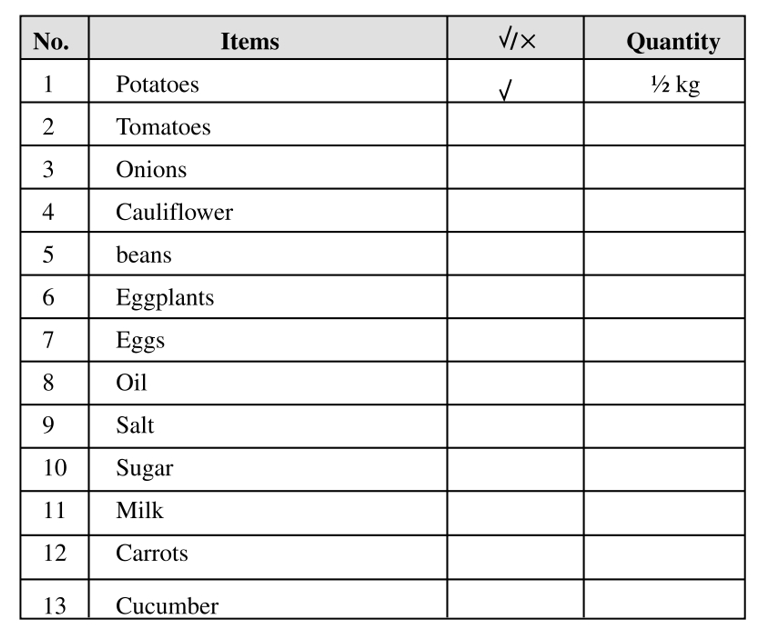
A1 . You have read the conversation above. Now, put a tick mark (✔) against the items that Imran will buy and put a cross mark (×) against the items he won't. Write the quantity of the items in the last column. (The first one is done for you.)
B . Listen to and read the dialogues below.
Salesperson Hello, how can I help you?
Imran Do you have any beans?
Salesperson Yes, we do. How much would you like?
Imran I would like half kg. And I'll also need one kg.of tomatoes, two kg of potatoes,
two cauliflowers, a dozen of eggs and some salt.
Salesperson Do you need oil, sir?
Imran Yes, I need a litre of oil.
Salesperson Do you need anything else?
Imran Umm..... let me check. (looks at the list). Oh, yes, could I have some sugar and milk?
Salesperson Sure. How much milk do you want?
Imran Just one litre, ...and one kg of sugar, please.
Salesperson Ok, let me find all the items for you.
Imran Thanks. Please put them in a paper or jute bag.
Salesperson Sure! We don't use plastic bags here. Here you go! I've put all the items here.
Imran Thank you. How much is the total?
Salesperson The total comes to Taka five hundred and thirty-five.
Imran Here is five hundred and fifty.
Salesperson Thank you. Here is the change, fifteen taka. Have a good day!
Imran Thanks, Bye.
B1 . Discuss the following questions in pairs.
a. How many items did Imarn buy?
b. What varieties of vagetables were available in the market?
c. Why do you think Imarn asked the salesman to use a paper bag? Discuss with your class friends and then write down one or two reasons.
d. "Thank you, here is the change,...". What does the word 'change' mean here?
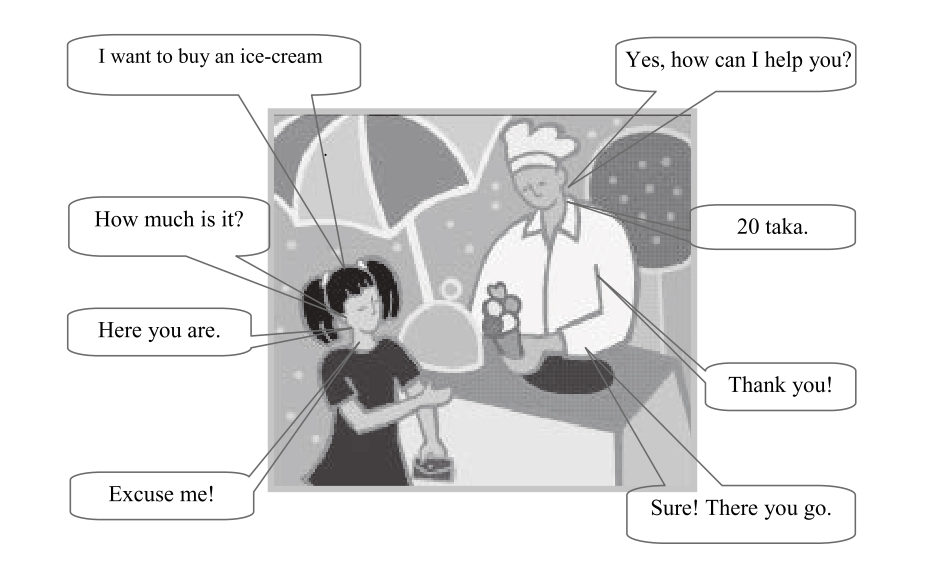
B2 . Read the sentences/phrases in the eight speech bubbles. Put them in the right order (1 to 8) to write down the conversation in your notebook.
C Discuss in pairs how you talk about quantities when you go shopping. Match the phrases in column A and the items in column B below to make an imaginary shopping list. Write down the list in your notebook. (One phrase may match more than one items.)
A | B |
a can of ________ a loaf of. _______ a packet of ________ a tube of. ______ half a kilo of. _______ a dozen ______ a box of ______ a roll of _____ a ______ a jar of _______ a sheet of _______ | poster paper bread paint facial tissue cake honey eggs chocolates toothpaste note book pencils coke |
C1 . Look at your shopping list again. Can you say which items are available in what kind of shops? There are different shops such as the grocer's, baker's, stationer's, etc. selling different things. Put the items under the proper headings in the table below.
Grocer's | Baker's | Stationer's |
a dozen of eggs | A loaf of bread | A tube of paint |
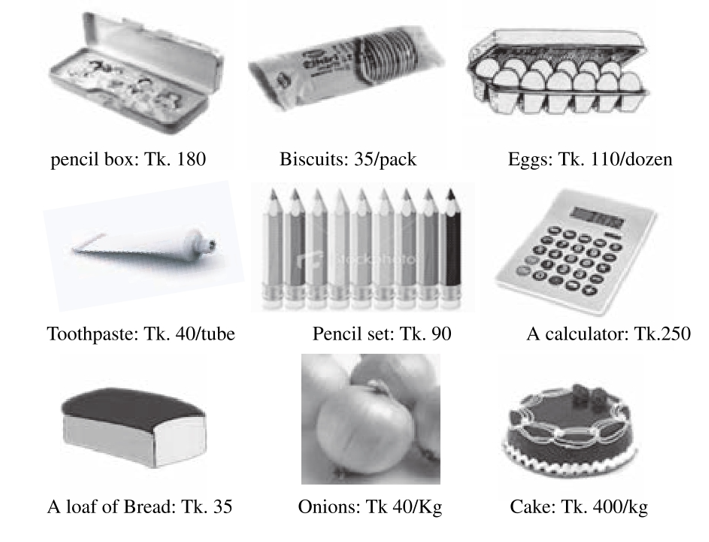
D . Work in groups. Create a mini market in the classroom. Put some signs like the Baker's, the Grocer's, the Stationer's etc. Some of you play the roles of shop assistants and some others will be customers. Now, the customers move round the room from one shop to the other asking the prices of the items shown in the pictures below. Use the following model.
A shopping day:
A - Have you got any noodles? / Do you have any noodles?
B - Yes, I have. / Yes, I do.
A - bHow much are they?
B - Taka twenty five a packet.
A - Can I have two packets, please?
B - Here you are. That's taka fifty altogether.
A - Thank you.
Language Focus: some and any
| We use 'some' with positive statements. Example: I've got some photographs. I need some milk. We use 'any' with negative statement. Example: I haven't got any photographs. I don't see any student there. We use 'any' with questions. Example: Have you got any photograph? Is there any water in the jug? |
E . Fill in the blanks with 'some' or 'any'.
- Are there ______ flowers in the garden ?
- Yes, these are ______ roses and ________lilies.
- What about jasmine? Are there ______ jasmines ?
- No, there aren't ______ jasmines.
- Do you have ______ idea why I'm asking you all these?

Read more